
In the world of SEO, understanding keyword intent is crucial. Lower funnel keywords are key players in this arena. They target users ready to make a purchase or conversion. These keywords often include specific product names or phrases like “buy now.”
Unlike top-funnel keywords, lower funnel keywords have high conversion rates. They are essential for businesses aiming to capture ready-to-buy customers.
These keywords are more competitive but offer higher ROI. They differ from low-intent top-funnel and educational keywords.
Integrating them into your strategy can boost sales and lead generation.
This guide will explore the importance of lower funnel keywords. Learn how to effectively use them to drive conversions and sales.
Summary
Lower funnel keywords are specific, high-intent, transactional queries that target ready-to-buy users at the bottom of the sales funnel, delivering higher conversion rates and ROI than top- or mid-funnel terms. This guide shows how to identify these terms (modifiers, research tools, autocomplete, forums), where to deploy them (product pages, CTAs, PPC), and how to craft content that converts while tracking performance. It outlines common mistakes to avoid, advanced tactics like personalization and retargeting across channels, and provides real-world examples. Emerging trends such as voice search and AI-driven intent modeling are also highlighted for future optimization.
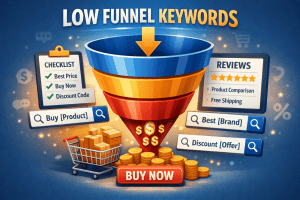
What Are Lower Funnel Keywords?
Lower funnel keywords are designed to target potential customers who are in the final stages of their buying decision. These individuals are typically ready to make a purchase, which makes them critical for conversion-driven strategies. Due to their high intent, these keywords have a higher likelihood of turning searches into sales.
Lower funnel keywords are characterized by their specificity. Often, they include particular product names, brand names, or purchase-related phrases such as “buy now” or “on sale.” This specificity helps in capturing users who have already done their research and are poised to complete a transaction.
Let’s break down the key traits of lower funnel keywords:
- High Intent: Directly linked to purchase decisions or actions.
- Specificity: Often include detailed product, service, or brand references.
- Conversion Focused: Aim to drive sales or lead completions.
Compared to top-funnel keywords, which attract broad interest, lower funnel keywords target a niche audience. This focus means fewer searches but higher conversions. When implemented correctly, these keywords can significantly improve the effectiveness of a digital marketing campaign.
Using these keywords effectively requires understanding the target audience’s search behavior. Businesses must ensure that their content meets the needs of this audience to capitalize on their search intent.
The Sales Funnel: Top, Middle, and Bottom Explained
Understanding the sales funnel is vital in digital marketing. It represents a customer’s journey from awareness to purchase. The funnel is typically divided into three stages: top, middle, and bottom. Each stage has distinct characteristics and objectives.
In the top funnel, the focus is on generating awareness. People at this stage are just beginning to explore a product or service. The middle funnel is about consideration. Potential customers start evaluating options based on their needs and preferences.
The bottom funnel is where conversion happens. At this stage, customers are ready to decide. Marketers aim to provide persuasive content to facilitate the purchase process.
Key stages of the sales funnel:
- Top Funnel: Awareness and interest generation.
- Middle Funnel: Consideration and evaluation.
- Bottom Funnel: Conversion and purchase decision.
Each stage requires a tailored approach. Understanding where users are in the funnel helps in crafting the right messaging. By aligning content with the funnel stages, businesses can move prospects seamlessly towards conversion.
Top-Funnel vs. Middle-Funnel vs. Bottom-Funnel Keywords
Keywords must align with the sales funnel stages. Top-funnel keywords attract broad searches, such as general product inquiries. These users seek information but have no purchase intent yet.
Middle-funnel keywords have more focus. They might include comparisons or reviews. These users are weighing their options, narrowing down choices.
Bottom-funnel keywords, however, show high intent. Phrases might include “buy” or “free shipping”. Users with such queries are close to purchasing.
Types of funnel-based keywords:
- Top-Funnel: Broad, informational, educational.
- Middle-Funnel: Comparative, evaluative.
- Bottom-Funnel: High intent, transactional.
Using the right keywords at each stage optimizes the customer’s journey. Tailored keyword strategies help engage users effectively. By meeting users’ needs at each funnel level, businesses can boost conversion rates.
Why Lower Funnel Keywords Matter for SEO
Lower funnel keywords are essential for reaching ready-to-buy customers. At this stage, users have a clear intent to make a purchase. These keywords often lead to higher conversion rates compared to others.
Focusing on lower funnel keywords improves the effectiveness of your SEO strategy. Such keywords usually include specific brand names or products. Phrases like “buy now” or “discount” are common signals of high intent.
By targeting these phrases, you attract users who are already convinced. They are simply looking for the best place to buy. This can result in a higher return on investment (ROI) for businesses.
Advantages of lower funnel keywords:
- Higher conversion potential.
- More specific search queries.
- Improved ROI for marketing efforts.
- Reduced cart abandonment rates.
- Enhanced focus on ready-to-buy customers.
Utilizing these keywords is crucial for businesses focusing on online sales. They help maximize conversions and drive sales. The competitive nature of lower funnel keywords can be challenging, but the rewards often outweigh the risks.
Lower Funnel vs. Low-Intent Top-Funnel & Educational Keywords
Understanding the difference between lower funnel and top-funnel keywords is crucial. Lower funnel keywords target users ready to make a decision. They are action-oriented and aim to convert interest into sales.
Top-funnel keywords, in contrast, focus on awareness. These are broader and attract a wide audience. They include more general or educational terms that may not lead to immediate sales.
Educational keywords serve as informational. They help users understand a product or service better. While they don’t often result in quick sales, they build brand awareness.
Key distinctions:
- Intent: Lower funnel is high; top-funnel is low.
- Conversion rates: Lower funnel typically higher.
- Audience reach: Top-funnel is broader.
- Purpose: Lower funnel converts; top-funnel educates.
Targeting both types within your SEO strategy offers balance. It caters to different stages of the customer journey. This holistic approach can optimize results across all levels.
Identifying High-Intent, Bottom of Funnel Keywords
To boost conversions, identifying high-intent, bottom of funnel keywords is crucial. These keywords align with the final decision-making stage. They attract users ready to act.
Often, high-intent keywords include specific actions or product details. Phrases like “buy,” “best price,” and “discount” signal strong intent. Users searching for these terms are typically ready to purchase.
Effective identification involves detailed keyword research. Tools like Google’s Keyword Planner can provide insights. Analyzing competitors can also reveal successful keyword strategies.
Consider customer intent when selecting keywords. Understand what prompts users to convert. Tailoring your keyword choices to these needs increases effectiveness.
Key characteristics of high-intent keywords:
- Transactional terms: Words that imply purchase or action.
- Specificity: Focus on particular products or services.
- Urgency: Incorporates time-sensitive phrases.

Common Modifiers and Examples
Modifiers are terms added to a keyword to increase specificity. For lower funnel keywords, they are vital. They transform generic terms into actionable queries.
Consider keywords like “buy iPhone 14,” where “buy” is a modifier. It shifts user intent from interest to action. Other examples might include “cheapest,” “near me,” or “2026 model.”
When crafting content, include these modifiers. They help align with users’ direct needs. This boosts both search relevance and conversion potential.
Examples of effective modifiers:
- Transactional: buy, order, purchase
- Comparison: best, versus, review
- Availability: in stock, for sale, near me
How to Find Lower Funnel Keywords: Tools and Techniques
Finding the right lower funnel keywords can be a game changer. It requires the right tools and strategies. Begin by understanding your audience’s needs and behavior.
Keyword research tools are incredibly helpful. They provide valuable data on keyword volume and competition. These insights help you identify keywords that drive conversions.
Consider using Google’s Keyword Planner. It’s a reliable source for discovering high-intent keywords. You can also explore your competitors’ keyword strategies using tools like Ahrefs.
Social listening can also be a powerful technique. It involves monitoring platforms where your audience is active. This includes social media channels and forums.
Additionally, analyze customer feedback and reviews. They can uncover common phrases that potential buyers use. This insight enhances your keyword targeting strategy.
Effective tools for keyword research:
- Ahrefs: Offers comprehensive keyword analytics.
- Google Keyword Planner: Provides search volume and CPC insights.
- SEMrush: Includes competitive analysis features.
Using Google Autocomplete, Reddit, Quora, and Forums
Google Autocomplete is a simple yet effective tool. Start typing your main keyword, and observe suggestions. These reflect popular searches related to your query.
Forums like Reddit and Quora are treasure troves of user intent. Explore discussions related to your niche. Users often share specific needs and preferences.
Participate in conversations to gain deeper insights. Note language and terms common among prospective buyers. This can help you refine your lower funnel keywords list.
Best practices for using forums and communities:
- Observe active threads: Focus on high-engagement topics.
- Identify common questions: Look for recurring user queries.
- Engage and learn: Ask questions to expand insights.
Leveraging Keyword Research Tools (Ahrefs, SEMrush, GSC)
Ahrefs is renowned for deep keyword analysis. It aids in discovering keywords competitors target. This offers an edge in competitive markets.
SEMrush provides a wealth of keyword data. It highlights keyword difficulty, trends, and search volume. These metrics are crucial for optimizing lower funnel keywords.
Google Search Console (GSC) is indispensable. It offers insights into performance and user behavior. Use it to track which keywords drive your traffic.
Steps to optimize with keyword tools:
- Analyze competitor strategies: Use Ahrefs for inspiration.
- Track keyword performance: Use GSC for ongoing analysis.
- Leverage trend data: Integrate SEMrush insights.
Optimizing Content for Lower Funnel Keywords
Optimizing content with lower funnel keywords is crucial for conversions. These keywords need strategic placement to be effective. Begin by integrating them naturally into the text.
Create compelling headlines and subheadings. These catch the eye and encourage further reading. Use your keywords in these key places for maximum visibility.
Ensure your content offers clear value. Explain what sets your product or service apart. Focus on addressing user needs and solving problems directly.
Craft your content with a conversion mindset. The goal is to prompt action, whether it’s a purchase or an inquiry. Use persuasive language and compelling calls-to-action.
Consider using a content checklist. This ensures that key elements are effectively optimized.
Key elements to optimize:
- Headlines and subheadings: Highlight your offer’s unique aspects.
- Product descriptions: Clearly convey benefits.
- CTAs: Use urgent and actionable language.
Where to Place Lower Funnel Keywords (Pages, CTAs, PPC)
Place your lower funnel keywords thoughtfully. Focus on key conversion points on your site. These include landing pages and product descriptions.
Integrate keywords into call-to-action (CTA) buttons. This encourages immediate action from potential buyers. Use action-oriented language combined with keywords to entice clicks.
Incorporate these keywords in your pay-per-click (PPC) campaigns. Keywords should align closely with ad copy to increase relevance and click-through rates.
Strategic placement areas:
- Product pages: Enhance visibility and clarify intent.
- CTAs: Boost conversion likelihood with targeted language.
- PPC ads: Align with searcher intent and expectations.
Content Types That Convert: Case Studies, Reviews, Comparisons
Certain content types excel at converting leads. Case studies, for instance, illustrate tangible success stories. They provide proof of value and influence buyer decisions.
Reviews build trust through customer testimonials. Highlighting specific results or benefits resonates strongly. Authentic reviews create a credible connection with potential buyers.
Comparisons clarify how your offering stands out. They address buyer doubts by showcasing advantages over competitors. Explicit comparisons can guide hesitant prospects towards making a choice.
Utilize a mix of these content types. Each serves a role in moving buyers down the funnel. Their collective impact boosts overall conversion metrics.
High-conversion content types:
- Case studies: Display real-world effectiveness.
- Customer reviews: Reinforce trustworthiness and reliability.
- Comparisons: Simplify decision-making by emphasizing benefits.
Integrating Lower Funnel Keywords into Your SEO Strategy
To integrate lower funnel keywords into your SEO strategy, start by understanding their role in conversions. These keywords are pivotal at the decision stage. Therefore, weave them into your SEO efforts to capture decisive visitors.
Diversify your strategy by blending lower funnel keywords with other digital marketing funnel stages. This ensures you cater to users at various steps of their journey. Your approach should be holistic, providing value throughout the funnel.
Utilize analytics tools to identify high-converting keywords. This data helps refine your targeting and optimize content. Effective integration requires continual assessment and adjustment.
Use the following strategic focus areas:
- Targeted landing pages: Tailor messages to high-intent users.
- SEO campaigns: Align with bottom-funnel goals.
- Regular updates: Adapt to shifts in market trends.
Balancing Lower Funnel and Top/Mid-Funnel Keywords
Balancing lower and top/mid-funnel keywords creates a comprehensive strategy. Start by understanding each keyword’s intent. Top-funnel keywords cast a wide net, gathering awareness-stage users. Conversely, lower funnel words aim to convert.
Effective balancing requires distributing efforts across the funnel. Allocate resources according to the goals of each stage. Monitor conversion data to gauge the effectiveness of your approach.
Develop a structured content calendar. This ensures a continuous flow of relevant content. Your content should naturally progress from awareness to conversion.
Tips for balancing strategies:
- Resource allocation: Distribute budget and efforts wisely.
- Progressive content: Lead users from awareness to decision.
- Continuous monitoring: Adjust based on data insights.
Measuring Success: Tracking and Analyzing Lower Funnel Keyword Performance
Measuring the success of lower funnel keywords involves tracking several key metrics. These metrics provide insights into how well your keywords convert. Begin by closely monitoring conversion rates, a direct indicator of keyword performance.
Analyze traffic sources to determine which channels drive conversions. This helps identify successful pathways for lower funnel engagement. Leveraging tools like Google Analytics can provide comprehensive data.
Bounce rates and session durations also reveal user engagement levels. High engagement often correlates with effective keyword targeting. Ensure your pages offer a seamless experience to retain users.
Regularly evaluate keyword performance to adapt your strategy as needed. Make data-driven decisions to refine campaigns. Continuous analysis ensures sustained SEO success.
Here are key metrics to focus on:
- Conversion rates: Measure direct keyword effectiveness.
- Traffic sources: Identify successful channels.
- Engagement metrics: Assess user interaction quality.
Common Mistakes to Avoid with Lower Funnel Keywords
When using lower funnel keywords, common mistakes can undermine efforts. Avoiding these pitfalls requires a strategic approach. Not focusing on user intent is one major error. Ensure your keywords align with what potential buyers seek.
Another mistake involves neglecting long-tail keywords. These often capture specific buyer intentions. Failing to incorporate them can limit your reach. Overlooking content quality also hinders success. Keywords in poor content may not convert effectively.
To guide your strategy:
- Misalignment with intent: Match keywords with true buyer needs.
- Ignoring long-tail variants: Capture more precise searches.
- Subpar content: High-quality content is essential.
Advanced Tips: Personalization, Retargeting, and Multi-Channel Approaches
Enhancing your lower funnel keyword strategy requires advanced tactics. Personalization can greatly impact engagement. Tailor content to individual user preferences for more meaningful interactions.
Retargeting plays a critical role in conversions. Re-engage users who have shown interest but not yet converted. Multi-channel approaches further amplify your reach. Integrating efforts across different platforms increases the chance of converting ready-to-buy customers.
Consider these advanced strategies:
- Personalized content: Customized for user preferences.
- Effective retargeting: Re-engage interested users.
- Utilize multiple channels: Combine efforts across various platforms.
Real-World Examples and Case Studies
To understand the impact of lower funnel keywords, let’s explore some real-world applications. Companies successfully utilizing these keywords often see increased conversions and sales. Case studies illustrate how focusing on bottom-of-funnel strategies transforms potential leads into loyal customers.
Consider a clothing retailer leveraging seasonal sale keywords. By targeting “buy summer dresses,” they attract ready-to-buy consumers. This strategy reduced cart abandonment rates and boosted their sales.
Another example is a tech company using product comparison keywords. By optimizing for terms like “best laptops 2023,” they reached informed consumers ready to decide. This approach enhanced their credibility and drove purchasing decisions.
Key takeaways from these case studies include:
- Target specific search intents: Convert interested customers.
- Leverage promotional keywords: Enhance online campaigns.
- Use comparison keywords: Boost brand trustworthiness.
Future Trends: Voice Search, AI, and Lower Funnel Optimization
Emerging technologies are reshaping how we approach SEO, especially concerning lower funnel keywords. Voice search is gaining traction, requiring a shift towards more conversational queries. This adaptation is vital for capturing purchase-ready users who rely on voice-activated devices.
Artificial intelligence enhances keyword strategies by refining user intent predictions. AI tools can analyze data patterns, offering insights into which bottom-of-funnel keywords drive conversions. Businesses that embrace these tools can better personalize their marketing efforts, aligning with customer needs.
To stay competitive, consider these trends:
- Incorporate conversational keywords: Adapt for voice search.
- Use AI analytics: Optimize keyword targeting.
- Personalize user experiences: Meet evolving consumer expectations.
Conclusion: Maximizing Conversions with Lower Funnel Keywords
Leveraging lower funnel keywords is essential for driving business growth. By understanding their role in the sales process, you can enhance conversions.
Focus on integrating these keywords into your strategy, aligning them with user intent. This will lead to more effective marketing efforts and ultimately boost sales. Keep refining your approach to adapt to changing market dynamics and harness the full potential of lower funnel keywords.